 by Tsani
 Acquiring a Strategic-Grade domain name can be a game-changer for a startup’s brand, credibility, and operating efficiency, but the how of acquisition carries meaningful financial and strategic implications. When the domain name is high in value and expected to materially benefit company performance, the acquisition decision moves beyond branding into capital strategy.
Two structures dominate these transactions as an alternative to cash-only deals: lease-to-own arrangements and equity-based deals. Both enable access to a Strategic-Grade domain name without a large upfront cash purchase, yet they differ sharply in how costs, risks, and incentives are shared over time. In venture-funded startups, where trust, brand control, and long-term value creation matter, these differences compound.
The analysis below compares lease-to-own and equity-based domain name acquisitions across price behavior, capital efficiency, incentive alignment, optionality, and impact on dilution and fundraising, with a focus on domain names that function as strategic assets.
Price Certainty vs. Performance-Linked Value
Lease-to-Own - Fixed Price Security
A lease-to-own deal locks in a predetermined price for the domain name, paid over time. This structure offers price certainty. The startup knows from day one exactly what the domain name will cost once fully paid off, regardless of how the company grows.
For example, the contract might fix the purchase at $300K, split into monthly installments, even if the domain names’ contribution to trust, conversion, and fundraising becomes significantly more valuable as the company scales. This certainty protects the founder from paying more if success amplifies the domain’s impact. The domain name owner, in turn, forgoes any future upside beyond the fixed price, trading potential appreciation for a guaranteed payout.
In high-growth scenarios, this can look attractive for the startup. All equity upside remains internal. However, the startup is equally committed to the fixed price if performance lags or the expected benefits take longer to materialize. The structure assumes certainty in outcomes that, in early and growth stages, rarely exists.
Equity-Based - Variable Cost, Shared Upside
An equity-based domain name acquisition pegs the domain’s economic value to the startup’s future performance. Instead of paying a fixed dollar amount, the founder compensates the seller with equity, usually measured as a percentage of the company at a defined valuation.
This means the effective price varies with outcomes. If the domain name helps unlock scale, the equity appreciates. If growth underperforms, the seller absorbs downside risk alongside the founders. In this structure, valuation risk replaces price certainty.
When the domain name is expected to improve performance, as with Strategic-Grade domain names, rather than merely signal intent, this variability aligns costs with reality. Equity-based deals turn the domain name owner into a participant in the company’s trajectory rather than a vendor with a capped return.
Capital Efficiency and Runway Preservation
Lease-to-Own - Pay Over Time, Conserve Cash
By spreading the cost over months or years, lease-to-own agreements preserve upfront capital compared to a lump-sum purchase. The startup gains immediate use of the domain name while maintaining short-term liquidity.
This model reduces the initial hit to the balance sheet, but it introduces a recurring fixed obligation into burn. Payments continue regardless of whether the expected performance lift arrives on schedule. The structure favors companies with predictable cash flow and confidence in near-term execution.
Equity-Based - Runway First
Equity-based deals often require little or no cash outlay at acquisition. For founders pursuing a Strategic-Grade domain name precisely because capital efficiency matters, this distinction is decisive.
Founders preserve runway for product development, hiring, and distribution by using equity as currency. Strategic-Grade domain names improve conversion, reduce acquisition cost, and strengthen fundraising outcomes, which is why equity-based acquisition reinforces rather than competes with growth priorities.
The trade-off is dilution. The benefit is time and leverage at the moment both matter most.
Alignment of Incentives Between Seller and Startup
Lease-to-Own - Transactional Alignment
In a lease-to-own structure, the seller’s incentive is finite. Payments completed. Ownership transferred. Relationship concluded.
The seller does not participate in the company’s growth, even if the domain name materially contributes to improved performance. During the lease period, incentives align narrowly around payment continuity rather than shared success.
Equity-Based - Shared Fate
Equity-based acquisitions align incentives around long-term outcomes. The seller benefits if the company grows. The domain name owner’s upside is directly tied to the startup’s performance.
This converts the relationship into a partnership-like dynamic. Risk and reward are shared. Strategic-Grade domain names function as a growth lever. Equity-based acquisition aligns incentives accordingly, allowing founders to deploy the name to accelerate growth while domain owners are compensated in proportion to the company’s success.
Optionality and Commitment
Lease-to-own structures provide theoretical exit optionality. Payments can stop. The domain name reverts. Losses are capped at sunk cost.
In practice, once a Strategic-Grade domain is deployed, reversing course carries brand, trust, and credibility costs that often outweigh the financial flexibility. Optionality exists, but it is rarely exercised without consequence.
Equity-based deals are more permanent. Ownership transfers immediately. Brand control is secured. The commitment is higher, but so is stability. For founders with high conviction in the asset, permanence reduces risk rather than increases it.
Dilution, Signaling, and Fundraising Narrative
Equity-based domain name acquisitions introduce dilution, but Strategic-Grade domain names often strengthen investor perception, signalling seriousness, category ambition, and long-term thinking.
Investors scrutinize proportionality, not structure. Small, clean equity allocations tied to a clear strategic asset are typically viewed as rational capital deployment. Lease-to-own avoids dilution but raises parallel questions around burn discipline and asset security.
Both structures can support fundraising. Equity-based deals simply align more cleanly with performance-driven assets.
Choosing the Structure When the Domain Name Drives Performance
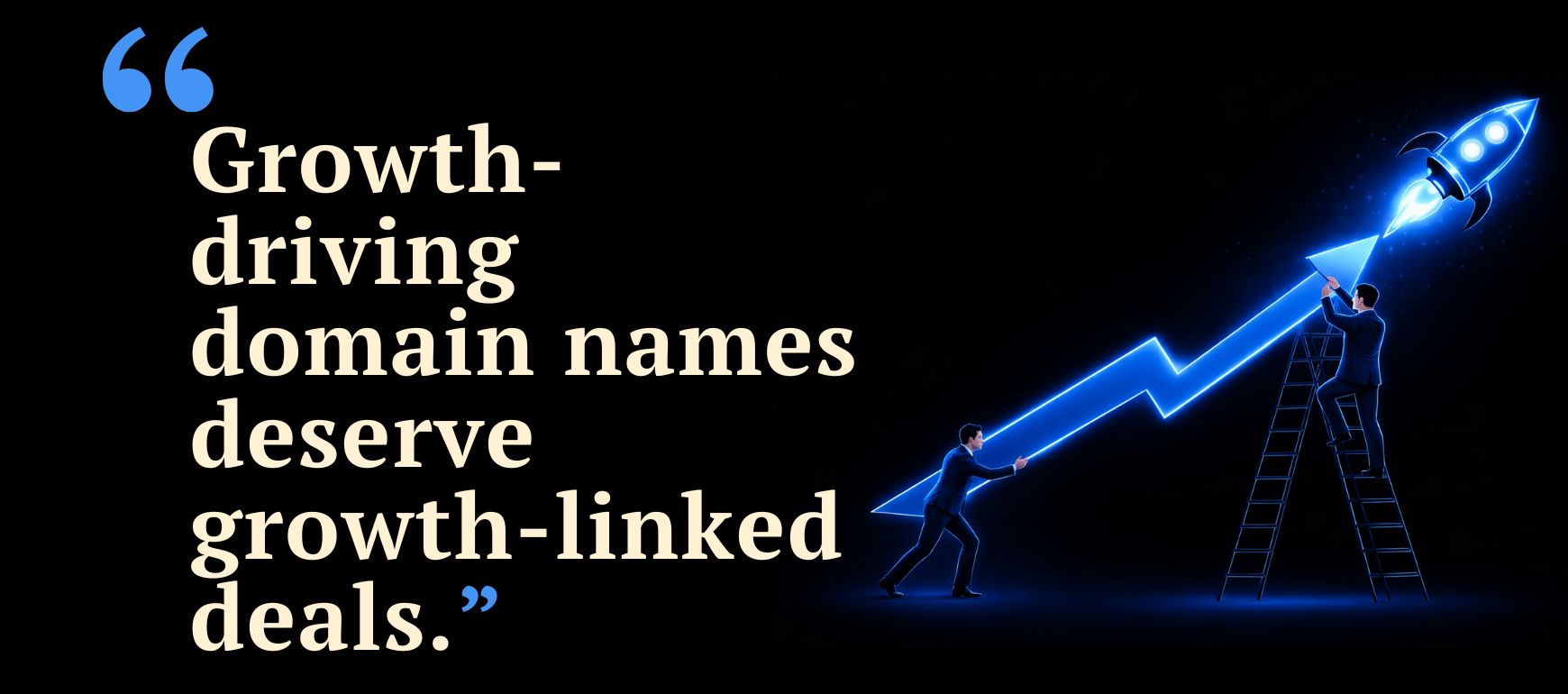
There is no universal answer. Structure depends on stage, cash position, and conviction. When a domain name is expected to materially improve performance, equity-based deals increasingly emerge as the default because they align price with outcomes, preserve runway, and distribute risk realistically.
Lease-to-own remains appropriate when growth is predictable and cash is abundant. Equity becomes the go-to when the domain itself is part of the growth engine.
Closing Perspective
Strategic-Grade domain names are acquired to perform. When that is the case, equity stops being a compromise and starts functioning as alignment.
The question is not how cheaply the domain can be acquired.
The question is how its value compounds.
Founders pursuing Strategic-Grade domain names can post a domain request and explore equity-based acquisition paths with owners who understand performance-driven value.